Indonesia has one of the most dynamic payment markets in Asia, but it does not operate like a card-first economy. In real checkout processes, merchants may lose or gain conversions based on their support for local bank transfers, e-wallets, and QR-based payments. Predictable payment settlement across islands, banks, and consumer apps is also crucial.
This guide is designed for teams making practical decisions about payment gateways in Indonesia. The potential users include:
Indonesian e-commerce and marketplace sellers looking to improve authorization and settlement outcomes
SaaS businesses collecting recurring payments from Indonesian customers
International merchants entering Indonesia who need local payment method coverage
Product, finance, and operations teams comparing payment providers in Indonesia using clear criteria.
Indonesia At A Glance
Key Statistics
#1 Largest Economy In The ASEAN Region
≈286.7 Million Total Population
≈5% Annual Economy Growth Rate
Regulatory Landscape
Bank Indonesia regulates the payment system framework. This includes payment system regulations and the licensing model for payment service providers. It is illegal to operate a payment gateway without a license.
Under the current regulatory framework, payment gateways no longer require a standalone “payment gateway” license. They are classified as Payment System Service Providers (known locally as Penyedia Jasa Pembayaran or PJP).
Payment Market Overview In Indonesia
Digital Commerce Size
Indonesia’s online economy is greatly influenced by mobile-first behavior and platform ecosystems. According to U.S. government trade guidance, internet penetration is expected to reach 79%, accompanied by over 180 million smartphone users. This explains the need for fast and app-native checkout experiences.
Payment Methods Trends
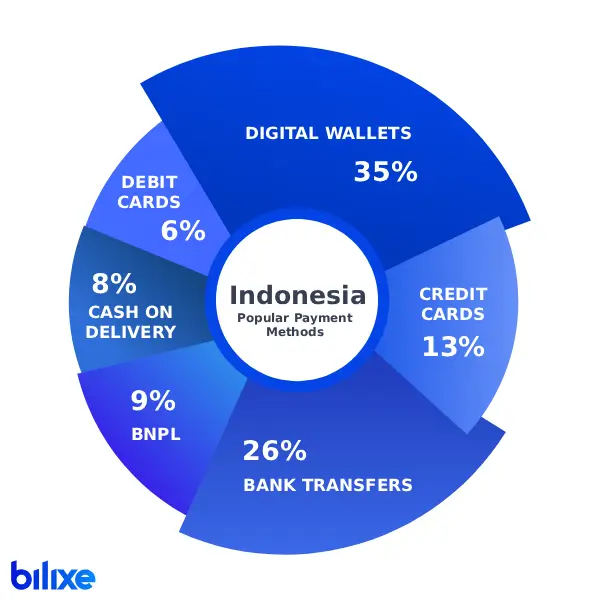
Indonesia’s online commerce is not dominated by cards. Industry data often shows digital wallets and bank transfers leading in e-commerce transactions, while cards play a smaller yet important role, especially for cross-border transactions and subscriptions. According to our PCMI’s E-commerce Data Library, the primary payment methods for e-commerce in Indonesia in 2024, by share of volume, are:
Bank transfer: IDR 4,000/transaction. Digital wallets: GoPay – 2%/transaction; QRIS – 0.7%/transaction; ShopeePay – 2%/transaction; DANA – 1.5%/transaction. Credit Cards (Visa, Mastercard, JCB, American Express, Google Pay): 2,9% + IDR 2,000/transaction. Over The Counter: Indomaret – Direct to partner + IDR 1,000; Alfamart, Alfamidi, DanDan – IDR 5,000/transaction. Cardless Credit: Akulaku PayLater – 1.7%/transaction; Kredivo – 2%/transaction.
Integration Options
Web Services API, Hosted Payment Page, Plugin Support, Webhook Support
Web Services API, Hosted Payment Page, Plugin Support, Webhook Support
Web Services API, Hosted Payment Page, Plugin Support, Webhook Support
Web Services API, Hosted Payment Page, iFrame, Plugin Support, Webhook Support
Web Services API, iFrame, Plugin Support, Webhook Support
Compliance
PCI DSS, AML/KYC Screening, ISO 27001
PCI DSS, AML/KYC Screening, 3D Secure Support, ISO 27001
PCI DSS, AML/KYC Screening
PCI DSS, ISO 9001, ISO 27001
PCI DSS, 3D Secure Support, ISO 27001
Customer Support
24/7 Support, Email Support, Live Chat
Email Support, Phone Support, Portal (Ticket)
24/7 Support, Email Support, Live Chat, Phone Support
Email Support, Phone Support
Live Chat, Portal (Ticket)
Complete List Of Indonesian Payment Gateways
Most merchants begin by comparing a few well-known providers. That strategy works if your needs are standard: IDR checkout, common e-wallets, QRIS, and bank transfers. However, Indonesia is a market where the “top 5” could be the wrong short list for practical reasons.
You should broaden your evaluation if any of the following apply:
You have cross-border needs.
Your business model is not a simple one-time checkout.
You operate in higher-risk segments.
You need niche local rails.
You prioritize operational control.
A wider directory also minimizes selection bias. If you only compare the most visible Indonesian payment gateways, you risk overlooking providers that better suit your specific checkout mix or business model.
Use Bilixe Filters To Narrow Options Faster
Use a simple rule to clarify your choices:
Start with your top two expected payment methods by volume (for many merchants, this means virtual accounts or bank transfer flows plus one or two major e-wallets and QRIS).
Choose the gateway that performs best for those methods, then validate cards and pay later as secondary options.
Eliminate any option that cannot clearly explain settlement behavior and refund timelines in a way operational teams can work with.
If you follow this, you will avoid the common pitfall of choosing a provider that “supports everything,” only to find out the methods your customers prefer are the least reliable in your setup
Bilixe’s filters are designed for that kind of evaluation. Build your short list by filtering for:
Currencies: IDR-only vs multi-currency, domestic vs cross-border
Integration options: APIs, hosted checkout, plugins, mobile SDKs, webhooks
Compliance and risk needs: PCI DSS, ISO certifications, 3D Secure, fraud tools
Support and operations: settlement expectations, reporting, refunds, dispute workflow.
Conclusion
The quickest way to choose among payment gateways in Indonesia is to stop searching for a universally “best” provider. Instead, select the one that best fits how your customers pay and how your finance team reconciles. Indonesia values practical alignment: method coverage, reliable settlement, and clear operations are more effective than feature-heavy lists that do not match real checkout behavior.
FAQ: Best Payment Gateways In Indonesia
Which payment methods are the most popular in Indonesia?
In 2024, e-commerce volume is led by digital wallets (35%) and bank transfers (26%). Cards are smaller (credit 13%, debit 6%), with buy now pay later at 9% and cash on delivery at 8%.
Are cards essential for Indonesian checkouts?
Indonesia is not a card-first market. Cards are important for specific cases such as international buyers, higher average order values, and subscriptions. However, many local transactions rely more on transfers, e-wallets, and QRIS.
What is QRIS and why does it matter?
QRIS is Indonesia’s interoperable QR payment standard. Supporting QRIS can simplify wallet coverage and enable fast, app-native payments.
Who regulates payment gateways in Indonesia?
Bank Indonesia is the main regulator for payment system licensing. Gateways are classified as payment system service providers (PJP), and it is illegal to operate a payment gateway without a license.
How long does onboarding usually take for a payment gateway in Indonesia?
Timelines differ by provider and risk profile. Expect KYC and business verification followed by technical setup and testing.
Do I need a local Indonesian entity to use a gateway?
Some providers support foreign businesses, while others require a local entity or a local bank account for settlement. Confirm eligibility, required documents, and settlement constraints before starting integration.
What is the difference between a gateway, acquirer, and payment facilitator?
A gateway routes payment data and manages checkout flows. An acquirer handles card acquiring and settlement. A facilitator can onboard merchants under its own acquiring setup. This model affects onboarding, risk controls, pricing, and settlement behavior.
What are the most popular payment gateways in Indonesia?